GEO vs SEO: what changes and what does not
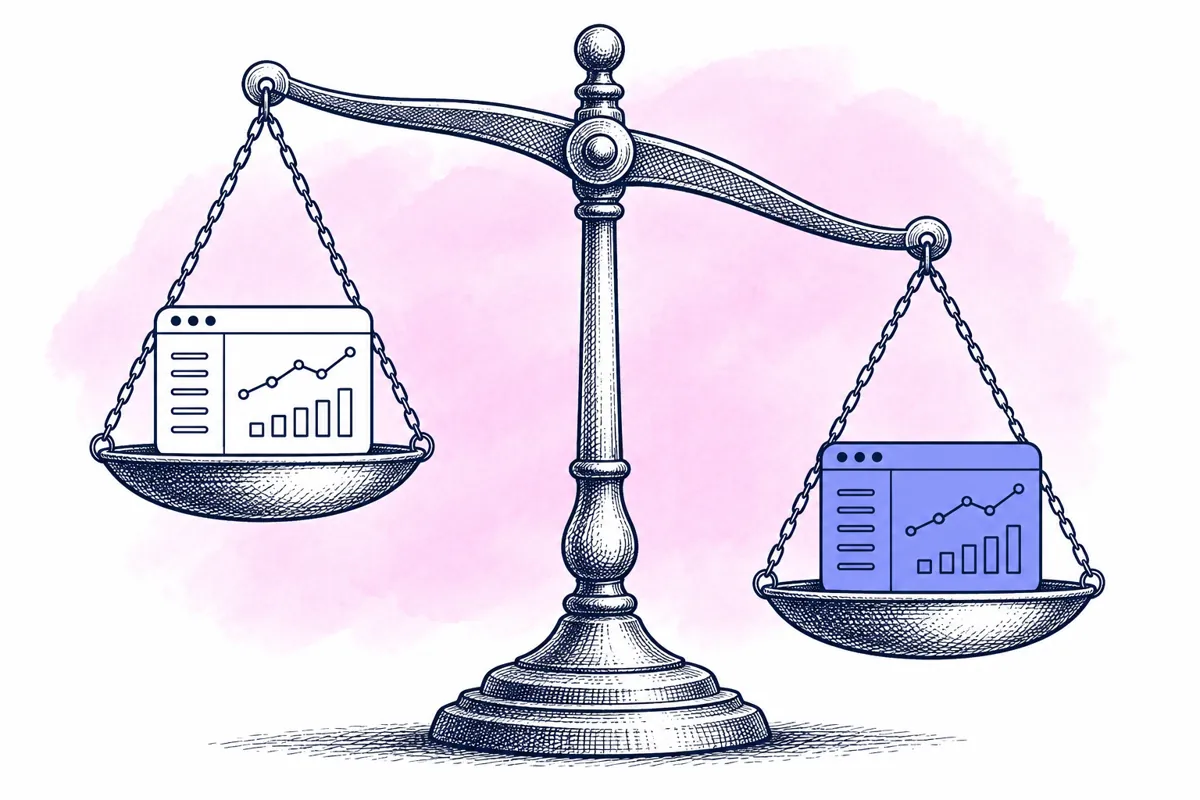
GEO vs SEO side by side
| SEO | GEO | |
|---|---|---|
| Where you appear | Google and Bing results pages, the map pack | Answers from ChatGPT, AI Overviews, AI Mode, Gemini, Perplexity, Copilot |
| Map results | Google's map pack | ChatGPT's own map list of businesses, shown in 47–68% of local answers |
| What you win | A ranked blue link or a map pin | Your name in the answer, your place in its list, your page as a cited source |
| Who decides | The search engine's ranking systems | A search step that picks pages, then a model that writes from them |
| What gets read | Your page, ranked against other pages | Several pages at once: your site, directories, review sites, licensing boards |
| Unit of measure | Position for a keyword | Share of answers that name you across repeated asks |
| How stable | Rankings change over days and weeks | The same question can name different businesses from one ask to the next |
| Off-site signals | Backlinks | The sites the answer cites, and whether they say the same about you |
| Shared foundation | Crawlable, indexable, fast pages with clear answers | The same: no crawl, no citation |
What does not change
Crawling and indexing
Google says its AI features use the same index as Search. ChatGPT search reads pages fetched by OAI-SearchBot. A blocked page is invisible to both.
One page per question
A page that answers one question for one service and one place is the page both rankings and answers pick.
Your own site first
In the median LA trade, 98% of ChatGPT's answers cited the site of a business they named.
Reputation off the site
Reviews, directory listings and licences matter to both, and the same sites show up as sources.
Most of the work is the same work, pointed at a new reader.
What does change
Three things change: the result is a sentence, not a position; the answer reads several sources at once; and the same question gives different answers on different asks. Each changes how you work and how you measure.
Read more
The result is a sentence. A search result shows your title and snippet and lets the searcher choose. An assistant chooses for them: it writes "three well-reviewed options are…" and lists names. Being on the page that was read is not enough; the model has to find a sentence it can repeat about you. Pages that state the service, the place, a price or a figure and the proof in plain words give it that sentence. Pages that rely on design, images or claims without facts do not.
Several sources at once. A ranking compares your page with other pages. An answer is assembled from your page and from what other sites say about you, often in the same paragraph. In the median trade of the LA Ranks study, directories were cited in 25% of answers, licensing boards in 11% and review sites in 10%. If those sites list a different phone, an old address or no licence, the answer can repeat the error or skip you.
Answers vary. A rank tracker can report one position per keyword because the results page is fairly stable. An AI answer is generated each time. The study asked every question 3 times because the names change between asks. So GEO is measured as a share: of all the times your customers' questions were asked, how often were you named, and in which place.
The practical consequence: an SEO report does not tell you what an assistant says. You need a separate reading of the answers themselves.
Is SEO dead? What the data says
No. ChatGPT with web search still reads websites, and mostly the websites of the businesses it names. What the data shows is that ranking well on Google does not carry over to AI answers by itself.
Read more
Two figures from the LA Ranks study of 126 Los Angeles trades frame the question. First, the website of a business named in the answer was cited in 98% of answers in the median trade: the assistant goes to business sites, which is exactly what SEO builds. A site that is slow to crawl, blocks AI search bots or hides its facts in images gives the assistant nothing to read.
Second, in the 10 trades measured on both ChatGPT and Google Maps, 48% of the Maps top-three places went to businesses ChatGPT never named, and 42% of ChatGPT's local mentions went to businesses in no Maps top 20. The two systems pick from overlapping but different sets.
So SEO is the entry ticket, not the result. A business that ranks in Maps can be absent from ChatGPT's answers, and a business ChatGPT names can be absent from Maps. Each channel has to be measured on its own, with its own questions, and fixed with its own levers.
Measuring GEO next to SEO
An SEO report shows positions; it does not show what an assistant says. LA Ranks AI reads the answers themselves: 60 of your customers' questions on 5 AI engines, each asked 3 times, from $79 a month.
Read more
Three things make the reading comparable with SEO data.
Questions weighted by demand. A keyword list is weighted by search volume; so are the LA Ranks AI questions, so a share of answers means a share of real customers, not of questions picked at random.
The map list. ChatGPT shows its own map list of businesses in 47–68% of local answers. LA Ranks AI records your place in it, your rating and reviews against the businesses listed, next to the answer text.
A fix list by lever. Each lost question is sorted into edit a page, build a page, get listed or fix a fact, with a ready draft and the cited page it must beat.
Starter is $79 a month, Growth $129 (measured twice as often), Agency $249 for 5 businesses. Paid plans are in early access: join early access.
Doing GEO on top of SEO
- Allow AI search crawlers (OAI-SearchBot, PerplexityBot, Googlebot) in robots.txt and in your CDN's bot rules.
- Open every service and area page with one sentence that answers its question, names the place and states a figure.
- Put prices, hours, service area, licence and phone in the page's HTML, not only in images or scripts.
- Keep the same name, phone and services on the directories and review sites cited for your trade.
- Give each service and each place you really serve its own page.
- Measure the same customer questions in AI answers before and after each change, several asks each.
See where you stand in AI answers
LA Ranks AI asks 3 of your customers' questions on ChatGPT and Google AI Mode with web search on and shows whether you were named, who was named instead, which sites were cited and whether you are in ChatGPT's map list.
Read next
 What is generative engine optimization (GEO)?
Generative engine optimization (GEO) gets AI assistants to name and cite your business. What it is, where the term comes from, and how to check it.
- AEO vs GEO vs SEO
AEO vs GEO vs SEO in one table: what each term means, where they overlap, which one to measure, and how to measure it with repeated AI answers.
- ChatGPT vs Google Maps
Does ChatGPT recommend the Google Maps top 3? In 10 LA trades, 48% of Maps top-3 places were never named by ChatGPT.
 How ChatGPT chooses which businesses to recommend
How ChatGPT picks the businesses and sites it cites: what OpenAI documents, and what 37,800 answers in 126 LA trades show.
- AI SEO
AI SEO (LLM SEO) step by step: let AI crawlers read your site, state facts a model can quote, fix the sources it cites, measure answers over many asks.
Questions
What is the difference between GEO and SEO?
LA Ranks AI data shows the two pick differently: in the LA Ranks study, 48% of Google Maps top-three places went to businesses ChatGPT never named. SEO wins a ranked link; GEO wins a mention and a citation inside an AI answer, and is measured as a share of repeated answers.
Is GEO replacing SEO?
No. AI assistants with web search read websites, mostly the sites of the businesses they name, so the crawlable, clear pages SEO builds are what GEO depends on. GEO adds a new goal and a new measurement on top.
Do I need both SEO and GEO?
If your customers use both Google results and AI assistants, yes, and they share most of the work. What GEO adds is checking what the assistants actually say and fixing the sources they cite.
Does ranking #1 on Google mean ChatGPT will recommend me?
Not by itself. In the 10 LA trades measured on both, 42% of ChatGPT's local mentions went to businesses in no Maps top 20 for the same question.
Is there a map pack in ChatGPT?
Yes. ChatGPT shows its own map list of businesses in 47–68% of local answers, and it is picked separately from Google's map pack: in the LA Ranks study 48% of Maps top-three places went to businesses ChatGPT never named.
What is SEO GEO?
"SEO GEO" or "SEO/GEO" usually means search optimization that covers both classic results and AI answers. In marketing, GEO here is generative engine optimization, not geographic targeting.
Is SEO dead because of AI?
No. In the median of 126 LA trades, ChatGPT cited a named business's own site in 98% of its answers. Sites still decide; rankings alone no longer show the whole picture.
See what ChatGPT says about your business
The questions your customers ask, what ChatGPT answers, who it names and the sites it cites. Free.
Check my business